

Scottsdale Rideshare Accident Lawyer
Rideshare Accident Lawyer Scottsdale, AZ
If you were injured in an Uber or Lyft accident in Scottsdale, you are probably dealing with more confusion than you expected. The driver may claim the company is responsible. The company may point back to the driver. The insurance coverage that applies depends on which phase of a rideshare trip was active at the moment of impact. The answer to that question determines which policy, which limits, and which adjuster you are negotiating against. Most injured passengers and drivers never see this coming.
Our Scottsdale, AZ rideshare accident lawyer has handled complex personal injury and multi-party vehicle claims for more than three decades. We know the arguments Uber and Lyft make to minimize their exposure, and we know how to counter them. Contact us at SL Chapman Trial Lawyers today for a free consultation. You won’t be billed for legal fees of any kind unless we recover fair compensation on your behalf.
Why Choose SL Chapman Trial Lawyers For Rideshare Accident Cases In Scottsdale, AZ?
Bradley M. Lakin has concentrated his practice in complex personal injury, product liability, and mass tort litigation since 1997. Rideshare accident cases are not simple two-party claims. They involve layered insurance coverage, disputed driver classification, platform liability questions, and often multiple defendants. Brad’s background in cases with exactly this kind of structural complexity is directly applicable.
His record reflects what that kind of preparation produces. Brad has been recognized by his peers as a Super Lawyer and named a Top 100 Trial Lawyer by the National Trial Lawyers Association. His case results include a $43,700,000 verdict in a wrongful death vehicle fire matter and a $46,750,000 verdict in a toxic exposure case. Both were products of thorough investigation and willingness to take a case through trial when the insurer refuses to fairly compensate an injured person.
Arizona Courts Knowledge and Insurance Litigation Background
John Wilborn has practiced law in Arizona for more than 30 years, representing injured clients in litigation against insurance companies and large corporations across state and federal courts throughout the state. John understands how coverage disputes get litigated in Maricopa County courts. When a TNC or its insurer disputes which policy applies and how much is available, John’s courtroom and insurance litigation background is what positions the case for a strong outcome.
If you need a personal injury attorney in Scottsdale, AZ who has taken on well-funded institutional defendants for three decades and built a track record across Arizona’s courts, John brings that history to your case.
Catastrophic Injury Advocacy Across All Crash Types
Alan Starker has more than 35 years of catastrophic personal injury litigation experience. Rideshare crashes can produce the same life-altering injuries as any high-force vehicle collision. Alan has secured numerous seven- and eight-figure verdicts for clients suffering from traumatic brain injuries, spinal cord damage, amputation, and the loss of a loved one. His practice is built around long-term damages calculation and trial preparation that serious injury cases demand.
Millions Recovered. Contingency Basis Only.
Our results reflect more than three decades of serious personal injury and vehicle accident litigation. The record includes a $9,500,000 recovery in a personal injury and wrongful death auto matter and a $2,500,000 recovery in an amputation injury case. We work entirely on contingency. No upfront costs, no retainer, no hourly billing. If we do not recover a fair settlement for you, you pay nothing.
⭐⭐⭐⭐⭐ What Our Clients Say
“My experience with this group has been invaluable. They have made everything step so easy and explained each step in detail. Dealing with medical issues is enough and they are making the rest seem like nothing. Thank you for helping during this awful experience” – Melinda Otoole
Read more reviews on our Google Business Profile.
Types Of Rideshare Accident Cases We Handle in Scottsdale
Rideshare accident cases arise in several configurations, and the legal and insurance analysis differs meaningfully across them.
- Accidents caused by the rideshare driver. When you are riding in a TNC vehicle and the driver causes an accident, the rideshare company’s commercial insurance policy is active. The challenge is establishing which coverage tier applies and whether the corporate insurer attempts to shift liability back to the driver’s personal policy.
- Accidents caused by a third-party. When a third-party driver causes the crash while you are in a rideshare vehicle, the at-fault driver’s liability policy is the primary recovery source. When that policy is insufficient, the TNC’s underinsured motorist coverage may apply.
- Rideshare driver injury cases. TNC drivers injured by third-party vehicles face two potential recovery tracks: the at-fault driver’s liability coverage and, if coverage is insufficient, the rideshare company’s UM/UIM policy. Whether the TNC’s UM coverage applies depends on the driver’s app status.
- Drunk driving cases. Some rideshare collisions involve impaired drivers, either the rideshare driver or another motorist on the road. These cases often involve clear liability, but they can still require careful investigation to document intoxication, review police reports, and gather evidence such as toxicology results or witness statements. Establishing the full scope of damages is also important, especially when serious injuries are involved.
- Wrongful death. When a rideshare collision results in a fatality, surviving family members face TNC insurance complexity in addition to the damages analysis required to quantify their complete loss.
- Highway accidents. Many rideshare trips involve travel on busy highways or major interstates around Scottsdale. High speeds can increase the severity of injuries and property damage, and determining fault may require accident reconstruction, traffic camera footage, or analysis of vehicle data. These cases can also involve multiple insurers if several vehicles are involved.
- Multi-vehicle rideshare collisions. Crashes involving a combination of cars, vans, bikes, pedestrians, and multiple at-fault parties require coordination across multiple insurers. When a commercial truck is among the vehicles involved, the liability analysis expands further.
Arizona Legal Requirements for Rideshare Accident Claims
Statute of Limitations
Under A.R.S. § 12-542, injured parties in Arizona have two years from the date of the crash to file a personal injury lawsuit. For wrongful death claims, the two-year window runs from the date of death. Missing this deadline forecloses recovery in almost every case. If a government vehicle was involved, a notice of claim under A.R.S. § 12-821.01 must be filed within 180 days: a far shorter deadline that applies even when the standard statute of limitations has not yet run.
Comparative Fault
Arizona follows a pure comparative fault rule under A.R.S. § 12-2505. Your recovery is reduced by your percentage of responsibility but not eliminated by it. In rideshare cases, insurers sometimes attempt to assign partial fault to passengers based on seating position or failure to use a seatbelt. These arguments require a factual and legal response, not acceptance.
Arizona’s Rideshare Insurance Minimums and Phase Coverage
A.R.S. § 28-4009 sets Arizona’s baseline auto insurance minimums at $25,000 per person and $50,000 per accident for bodily injury, plus $15,000 for property damage. For rideshare drivers actively operating on a platform, the applicable coverage is substantially higher, and which tier applies depends on the driver’s status in the app at the time of the crash:
Phase 1 — App off: The driver’s personal auto policy applies. If that policy excludes commercial activity, coverage may be disputed entirely.
Phase 2 — App on, waiting for a request: The TNC’s contingency coverage provides limited liability protection (typically $50,000/$100,000/$25,000), but only if the driver’s personal policy denies the claim. This phase generates the most contested coverage disputes.
Phase 3 — En route or ride in progress: The TNC’s full commercial policy applies: up to $1 million per incident for Uber and Lyft in Arizona. This is the coverage most seriously injured passengers are entitled to during an active trip.
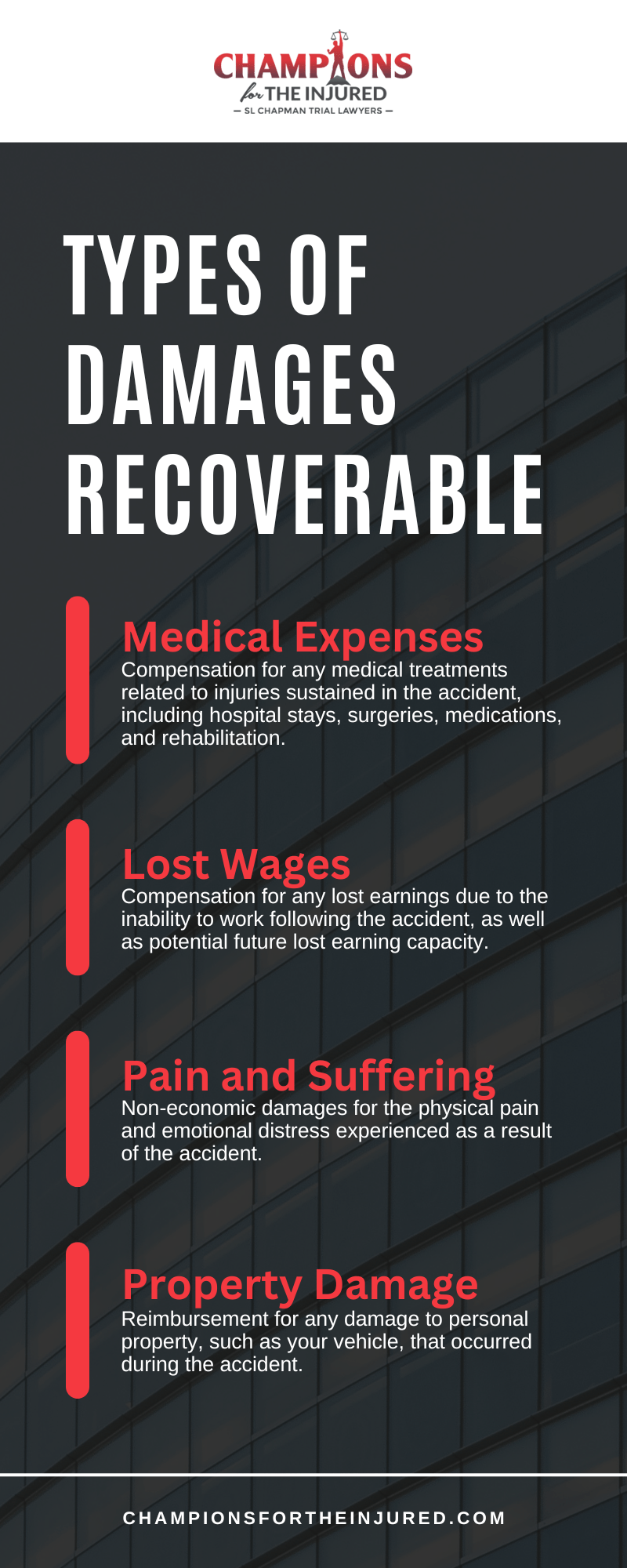
What Damages Are RecoverableIn A Scottsdale Rideshare Accident?
Compensation in a rideshare accident case in Scottsdale falls across three categories.
Economic Damages
Economic damages cover your actual and projected financial losses. In rideshare accident cases, these typically include:
- Emergency and ongoing medical treatment, including hospitalization, surgery, and post-acute care
- Future medical expenses: projected surgeries, physical therapy, assistive devices, and specialist care
- Lost wages and reduced earning capacity if injuries permanently affect your ability to work
- Out-of-pocket costs including transportation to appointments and in-home assistance
For rideshare passengers who sustain brain injuries or spinal cord injuries, projected lifetime care costs can exceed all other damages combined and must be fully documented before any case is resolved.
Non-Economic Damages
Non-economic damages compensate for losses that are real but not reducible to a dollar figure on a receipt. These include:
- Physical pain and suffering, past and ongoing
- Emotional distress and psychological trauma
- Loss of enjoyment of life when injuries prevent previously valued activities
- Disfigurement and permanent physical changes
- Loss of consortium for spouses and close family members
Punitive Damages
Arizona courts may award punitive damages when the at-fault party’s conduct was intentional, reckless, or malicious. In rideshare cases, this standard may apply when a driver was intoxicated or when a TNC’s pattern in screening or retaining dangerous drivers reflects conscious disregard for passenger safety. Punitive damages are not available in every case, but are worth evaluating where the facts warrant it.
What Steps Should I Take After A Rideshare Crash in Scottsdale?
1. Get medical care immediately. Do not decline emergency evaluation. TBI and spinal trauma frequently produce no obvious symptoms in the first hours. A medical record beginning on the day of the crash is foundational to your claim.
2. Call the police. Confirm that a report is generated and get the report number and officer’s name before leaving the scene.
3. Screenshot the app before closing it. Take screenshots of your trip details, the driver’s name and photo, vehicle information, and trip route. This documents that an active ride was in progress, establishing Phase 3 coverage status.
4. Photograph the scene. Both vehicles, visible injuries, road conditions, traffic signals, and any debris. The more documentation captured immediately, the stronger the evidentiary record.
5. Get witness contact information. Full name and phone number from anyone who observed the crash. Witnesses become significantly harder to locate within 48 to 72 hours.
6. Do not speak with any insurer before retaining counsel. Neither the driver’s insurer nor the TNC’s insurer is there to fairly evaluate your claim. You have no obligation to give a recorded statement to either. Do not discuss the crash, your injuries, or your treatment before speaking with an attorney.
7. Keep a daily symptom journal. Notes on your pain levels, functional limitations, and how daily life is affected provide documentation that medical records alone do not fully capture. Non-economic damages depend on this record.
8. Follow all treatment instructions without gaps. Gaps in care are among the most common arguments insurers use to minimize injury claims. Attend every scheduled appointment and follow your doctor’s instructions.
9. Do not post about the crash on social media. Defense counsel monitors claimants’ social media. Posts about your activities or condition can be used against you in litigation.
10. Contact a Scottsdale rideshare accident attorney as soon as you can. TNC app data is purged after a limited period. Preservation demands must go out immediately. Early legal contact is the most direct way to protect the evidence your case depends on.
Rideshare Accident Statistics In Scottsdale, AZ
Rideshare use across Scottsdale and the greater Phoenix metro has grown substantially, and crash involvement has grown with it. The platform-based driver model places a large, rotating population of drivers on Scottsdale’s roads at all hours, from the Loop 101 and Scottsdale Road to Old Town surface streets, the resort district, and late-night entertainment areas where rideshare demand is concentrated.
NHTSA crash statistics document traffic fatalities across all vehicle categories. Distracted driving consistently appears as a major contributing factor, and TNC drivers are structurally more exposed to app-based distraction than the average driver. NHTSA’s distracted driving research confirms that in-vehicle device use significantly elevates crash risk: a finding directly applicable to rideshare cases where app activity at the time of the crash is part of the evidentiary record.
Arizona’s AZDOT crash records system tracks statewide traffic collision data. Maricopa County accounts for the highest crash volume in Arizona, and Scottsdale’s rideshare concentration (amplified by tourism, events, and spring training season) means TNC crash exposure here is elevated relative to less densely served areas of the state.
The CDC’s transportation safety research identifies vehicle crashes as among the leading causes of serious and fatal injury for American adults. When rideshare crashes produce serious injuries, the economic and non-economic costs frequently exceed early insurer offers, particularly when the TNC’s commercial policy is fully available and should be fully claimed.
Scottsdale Rideshare Accident Infographic
Scottsdale Rideshare Accident Lawyer FAQs
Rideshare accident cases generate legal questions that are genuinely distinct from standard vehicle crash claims. The following addresses issues specific to Uber, Lyft, and TNC accident claims in Scottsdale, Arizona.
Can I sue Uber or Lyft directly, or only the driver?
The TNC may be a direct defendant in appropriate cases, particularly where a background check failure, inadequate screening, or negligent supervision contributed to the crash. The independent contractor label Uber and Lyft assert is a defense position, not a legal determination. Whether the platform bears direct liability depends on the facts of the crash and how courts analyze the degree of control the platform exercised. We investigate this issue in every rideshare accident case we take.
What if the Uber or Lyft driver was uninsured personally?
During an active trip (Phase 3), the TNC’s commercial policy applies regardless of the driver’s personal insurance. The platform’s coverage is its own, the driver’s personal policy is a separate layer. A personally uninsured driver in a Phase 3 crash does not leave you without a coverage source.
What if I don’t know whether the ride was active at the time of the crash?
App status is established through TNC trip logs, GPS records, and platform activity records, obtained through litigation discovery and preservation demands sent at the start of representation. It is not a matter of taking anyone’s word for it.
Does my injury claim differ if I was a passenger versus a third-party motorist?
The structure of the claim differs. Passengers injured during an active trip have the clearest path to the $1 million commercial policy, while third-party motorists must establish which coverage phase applies based on the driver’s app status. But both configurations support valid claims, and both are worth pursuing with counsel who understands TNC coverage frameworks.
What if the rideshare driver fled the scene or cannot be identified?
TNC app records may identify the driver even without physical evidence from the scene. GPS data, trip records, and platform logs create a documented trail. Additionally, your own uninsured motorist coverage may apply in hit-and-run scenarios where the at-fault driver cannot be identified or located.
What if multiple passengers in the same rideshare were injured?
Multiple injured parties create competing claims against the same policy limits. Individual legal representation matters in these cases to ensure each claim is fully valued and to navigate how shared limits are distributed.
Can the rideshare company access all of my medical records?
Not without proper authorization or a court order. Never sign a blanket medical records release. Insurers are entitled to records relevant to injuries from this specific crash, but not your complete medical history. We manage what is produced and to whom.
What if I agreed to Uber or Lyft’s arbitration clause?
Both platforms include arbitration provisions in their user agreements. Whether those clauses apply to personal injury claims, whether they are enforceable under Arizona law, and what exceptions exist are legal questions we evaluate at the start of every rideshare case.
What if the Uber or Lyft driver was not the at-fault party?
If a third party caused the crash, your claim runs primarily against that driver. The TNC’s uninsured/underinsured motorist coverage may apply as a supplement if the at-fault driver’s policy is insufficient. We identify all applicable coverage regardless of fault allocation.
What compensation can I recover after a rideshare accident?
Past and future medical expenses, lost wages, diminished earning capacity, pain and suffering, loss of enjoyment of life, and where the conduct warrants it, punitive damages. Arizona permits recovery for the full scope of economic and non-economic losses caused by another party’s negligence. Future medical costs and projected income loss are often the largest components in serious injury cases and require professional documentation to present effectively.
How is a rideshare accident different from a standard car crash claim?
The TNC as a potential defendant, the three-phase insurance structure, platform data as key evidence, and the contested driver classification issue all distinguish rideshare cases from standard two-party car crashes. Evidence preservation, coverage analysis, and platform liability investigation are structurally different from a claim involving only two personal auto policies. That distinction affects both how the case is built and how it resolves.
The questions above address a portion of what rideshare cases can involve. Speaking with an attorney before making any statements to any insurer is the single most important protective step you can take.
Most Dangerous Locations For Rideshare Accidents in Scottsdale
Scottsdale’s rideshare accident risk is concentrated in areas with high TNC trip volume, heavy pedestrian activity, and elevated nighttime traffic density.
- Old Town Scottsdale corridor (Scottsdale Road between Indian School Road and Camelback Road) – The highest rideshare pickup and dropoff density in the city during evening and weekend hours. Frequent double-parking by TNC vehicles and high pedestrian volume combine to produce elevated crash risk.
- Scottsdale Quarter and Kierland area – Retail and restaurant density with high TNC activity and complex parking lot entry/exit conflicts.
- Fashion Square area (Camelback Road at Scottsdale Road) – High vehicle volume and TNC staging that frequently conflicts with standard traffic flow.
- Spring training corridors – Seasonal surge events generate TNC volume spikes that overwhelm normal traffic patterns around Salt River Fields and Scottsdale Stadium.
- Resort Row (Scottsdale Road north of McCormick Parkway) – Year-round resort and convention traffic with high TNC demand and unfamiliar drivers navigating hotel entrance configurations.
- Scottsdale Airport area – Pickups involve drivers navigating unfamiliar access roads while managing app instructions simultaneously.
If you were injured at any of these locations, contact our team as soon as you can.
What Are Important Local Resources for Scottsdale Rideshare Accident Victims?
The following resources may be useful after a rideshare crash in Scottsdale, AZ.
These are listed as a public service only — SL Chapman Trial Lawyers does not endorse and has no affiliation with any organization listed below.
- Scottsdale Police Department – For crash reports, incident numbers, and non-emergency law enforcement assistance.
- HonorHealth Scottsdale Thompson Peak Medical Center – Emergency and inpatient care in north Scottsdale. (480) 324-7000
- Mayo Clinic Hospital – Arizona – Advanced neurology, orthopedics, and trauma services. (480) 515-6296
- Arizona Department of Transportation – For official crash record requests and transportation safety information.
- Maricopa County Superior Court – For civil filings, case status, and court information relevant to personal injury litigation in Arizona.
Contact SL Chapman Trial Lawyers
Rideshare accident cases move quickly against the clock. App data and GPS records are critical evidence, and TNC systems purge them after a limited period. Early legal contact is the most direct way to protect the evidence your case depends on.
We represent Scottsdale rideshare accident victims on a full contingency basis — no fees unless we recover for you. Reach us through our online intake form or visit our Scottsdale law office for more information. We will give you a candid assessment of your case.